he image is seared into memory: Steve Nash, hair flopping, dribbling into the lane, while Kobe Bryant cuts baseline, demanding the ball with a sharp wave. They were supposed to redefine basketball in Los Angeles. Instead, Kobe and Nash became a case study in what happens when two brilliant minds share a court but not a timeline. I still remember the hype in 2012—Nash arriving via sign-and-trade, Kobe fresh off a scoring title, Dwight Howard looming. It felt like a cheat code. Then reality hit: Nash broke his leg in the second game, Kobe tore his Achilles in the 80th。and the Lakers limped to a first-round sweep. That season remains the most frustrating 'what-if' of the 2010s.What made the Kobe and Nash pairing so tantalizing was their contrasting genius. Nash, the maestro of the pick-and-roll, thrived on pace and precision—his Suns teams averaged over 100 possessions per game. Kobe, the assassin, preferred isolation and mid-range mastery. On paper, Nash's vision and Kobe's scoring should have meshed like peanut butter and jelly. In practice, injuries robbed us of seeing it unfold. I watched a handful of games where they ran a simple dribble handoff, and you could see the gears grinding—Nash hesitating, Kobe cutting early. It was never smooth。but the flashes were electric. A no-look pass from Nash to a trailing Kobe for a dunk against Dallas still lives in my head.Beyond stats。the Kobe and Nash relationship had layers. Both were fiercely competitive, but Nash's approach was cerebral and team-first;
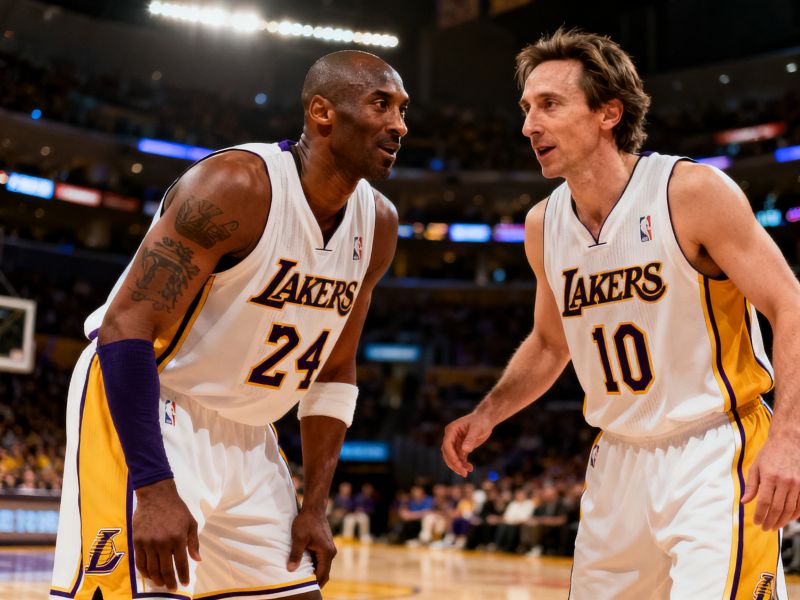
Kobe's was ruthless and individual. They clashed privately, according to reports, over offensive philosophy. Yet they respected each other's work ethic. When Kobe tore his Achilles, Nash was one of the first to visit him in the hospital. That gesture spoke volumes. Nash later said, 'Kobe wanted to win so badly it hurt.' I think that sums it up. Two legends, different roads, same destination that never arrived. Nash retired in 2015, Kobe in 2016. Their Lakers tenure yielded zero playoff series wins, which feels almost criminal given their talent.What did we learn from the Kobe and Nash experiment?For me, it's a cautionary tale about fit and timing. Pairing superstars isn't plug-and-play;it requires health, sacrifice, and a system. Mike D'Antoni tried to install a Nash-friendly offense, but Kobe resisted—he was 34, still averaging 27 points, and wasn't about to become a spot-up shooter. The result was a disjointed offense that ranked 11th in efficiency。
decent but not dominant. I often wonder what a healthy Kobe and Nash could have done with a full training camp and a defensive-minded coach. The mind spins. But basketball doesn't deal in hypotheticals. The Kobe and Nash era in L.A. ended as a footnote, yet their individual legacies remain towering. Nash's two MVPs and Kobe's five rings weren't built together, but their brief collision left a mark—a reminder that greatness doesn't always multiply.